 how-to
How to Verify Mechanic Repair Estimates: A Step-by-Step Guide
Last Updated: October 23, 2026
Quick Summary
To verify mechanic repair estimates, check three things: confirm the diagnosis is correct by asking how the mechanic tested for the problem, review the itemized costs line by line against the work described, and ensure the repair scope matches what you approved in writing.
- Request a written diagnostic report listing the symptom, what was tested, what was found, and why the repair is recommended.
- Use the line-by-line verification checklist to confirm part numbers fit your vehicle, parts are specified as OEM or aftermarket, labor hours are reasonable, and all fees are disclosed.
- Compare written estimates from at least two shops for the same repair to reveal whether a quote is overpriced or uses different parts quality.
- Require the shop to contact you in writing before exceeding the estimate by a stated amount or percentage, and keep all estimates and authorizations together.
- Ask the mechanic whether the repair is urgent, what happens if you skip it, whether temporary solutions exist, and what warranty covers the work.
Table of Contents
- Why Verifying Repair Estimates Matters
- Step 1: Confirm the Diagnosis Before Accepting Costs
- Step 2: What Should Be Included in an Auto Repair Estimate
- Step 3: Compare Mechanic Repair Quotes Across Shops
- Step 4: Questions to Ask a Mechanic Before Approving Repairs
- Step 5: Use a Car Repair Cost Estimator to Benchmark Prices
- What to Do When Estimates Differ Substantially
- Know Your Consumer Protections and Estimate Approval Rules
- Frequently Asked Questions
Why Verifying Repair Estimates Matters
Learning to verify mechanic repair estimates is your first defense against unexpected costs and unnecessary work. Many owners accept the first quote without question, then feel blindsided when the final bill is higher or includes unapproved repairs.
A written estimate is a contract, understanding it protects you.
Verifying a repair estimate means checking three things: the diagnosis is correct, the itemized costs match the work described, and the scope matches what you approved. Skipping this means trusting the shop's judgment unverified, fine with a shop you know, essential with a new mechanic or a major repair.
The stakes are real: a misdiagnosis leads to unneeded repairs, inflated labor rates cost hundreds, and scope creep happens when estimates aren't clearly documented.
Step 1: Confirm the Diagnosis Before Accepting Costs
Before worrying about price, confirm the mechanic identified the right problem. A wrong diagnosis leads to wrong repairs, wasting money and leaving your vehicle broken.
Ask the mechanic to show you the problem and walk you through the diagnostic process, what they found, why it's failing, and how they tested for it.
Request a written diagnostic report listing the symptom you reported, what the mechanic tested, what they found, why they believe this is the cause, and what repair they recommend.
Step 2: What Should Be Included in an Auto Repair Estimate
A complete estimate breaks down every cost, but the real skill is learning to verify mechanic repair estimates by checking each line against the work described. Use the checklist below before you approve any estimate.
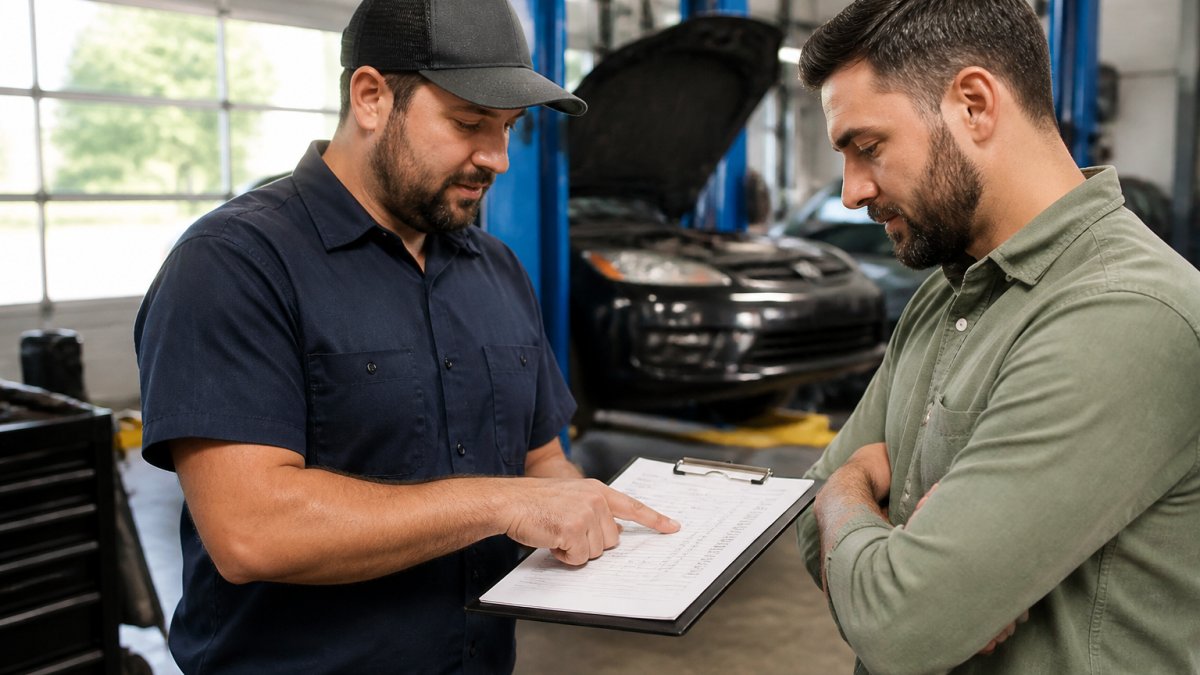
The Line-by-Line Verification Checklist
Work top to bottom. For each line, ask the question in the right column and note the answer on your copy of the estimate.
| Estimate line | What to verify | Question to ask |
|---|---|---|
| Customer concern | Matches the symptom you reported | "Does this describe exactly what I told you?" |
| Diagnosis | Tied to a specific test result | "What test confirmed this?" |
| Part number and description | Correct part for your year/make/model/trim | "Can you confirm this part number fits my VIN?" |
| Part type | OEM, aftermarket, or used, stated explicitly | "Which type is this, and what warranty does it carry?" |
| Part price | Comparable to a retail lookup for the same part type | "Is this price for the part only, or marked up?" |
| Labor operation | Matches the repair, not a broader job | "What labor operation code is this?" |
| Labor hours | Reasonable for the operation | "How many hours are you charging, and at what rate?" |
| Diagnostic fee | Itemized separately and disclosed upfront | "Is this fee waived or applied if I approve the repair?" |
| Shop supplies | Flat fee or percentage, disclosed | "Is this a flat fee or a percentage of the job?" |
| Taxes | Applied correctly to parts and labor per local rules | "How are parts and labor taxed here?" |
| Total | Adds up; no unexplained line items | "Can you walk me through the total?" |
| Authorization | Written approval required before work begins | "Will you call me before exceeding this estimate?" |
If any row can't be answered, pause. A shop that can't explain a line item hasn't documented it.
Parts and Labor Breakdown
The estimate should list each part separately with its cost and state whether it's OEM, aftermarket, or used.
- OEM parts are made by your vehicle's manufacturer. They cost more but fit precisely and typically carry the manufacturer's warranty.
- Aftermarket parts are made by third-party companies. They cost less and work well for many repairs, but warranty terms vary widely by brand.
- Used parts come from salvage yards. They are cheapest but carry higher risk of failure and usually a short or no warranty.
Ask which type the shop is using and get it specified. You generally have the right to choose, though some shops price part types differently and some won't warranty customer-supplied parts.
Labor costs should list hours required and the hourly rate. Many shops use flat-rate labor, a set number of hours per repair based on published labor-time guides, regardless of actual time spent.
Diagnostic Fees and Inspection Costs
Many shops charge a diagnostic fee that varies with complexity, a simple code read costs far less than a drivability diagnosis requiring hours of testing. The estimate should itemize it separately.
Some shops waive the diagnostic fee if you approve the repair; others apply it toward the total. Ask upfront and get the answer in writing on the estimate.
Shop Supplies, Taxes, and Additional Fees
Shops also charge for supplies such as cleaners, lubricants, and fluid disposal. These should appear as line items, not be buried in labor.
Taxes apply to parts in most jurisdictions, and labor is often taxed differently, ask your shop how it applies tax to each line.
Shop supplies are often charged as a percentage or flat fee, confirm it's disclosed and included in the estimate total, not added later.
Step 3: Compare Mechanic Repair Quotes Across Shops
Multiple estimates take time but protect you. Quotes for the same repair vary significantly, and comparing them reveals whether a shop is overpriced or using different parts quality.
Request written estimates from at least two shops describing the same repair the same way. If one recommends replacing a part and another repairing it, ask both why.
Evaluating Labor Rates and Flat-Rate Labor
Labor rates vary by location, reputation, and technician experience. Shops with ASE-certified technicians typically charge more, and that premium often reflects quality.
Flat-rate labor is common: the shop assigns a set number of hours based on industry standards.
Compare flat rates by asking "How many hours are you charging for this repair?" then multiply by the hourly rate to see total labor cost.
Distinguishing OEM, Aftermarket, and Used Parts
Check whether shops use the same parts quality. A cheap estimate might use salvage-yard parts while a higher one uses new OEM parts.
Ask each shop: "What parts are you using, and what warranty do they carry?" A used part might fail in six months; a new OEM part might last five years. The lowest price isn't always the best value.
Step 4: Questions to Ask a Mechanic Before Approving Repairs
Before signing off, ask these questions. The answers reveal whether the shop is transparent and thorough.
"Is this repair necessary right now, or can it wait?" Some repairs are urgent (brake failure).
"Are there temporary solutions?" Some problems have cheaper short-term fixes.
"What's your warranty on this repair?" Reputable shops warranty their work for 30 days to one year.
"Can I get the old parts back?" Some customers want to see what was replaced.
Step 5: Use a Car Repair Cost Estimator to Benchmark Prices
Online repair cost estimators compare a shop's quote against typical market rates.
Enter your vehicle's year, make, model, and repair type; the tool generates a cost range based on national averages.
Common cost estimators include manufacturer databases and third-party automotive websites.
Remember: estimators use averages. Your specific vehicle, your local market, and your shop's experience level all affect the actual price.
What to Do When Estimates Differ Substantially
Large gaps between estimates signal a problem. Either one shop is overpriced, one is cutting corners, or they're recommending different repairs entirely.
Start by confirming both shops are recommending identical repairs.
If both recommend identical repairs but prices differ by more than 20%, dig deeper.
After comparing explanations, choose based on value, not just price.
If you're still uncertain, get a third opinion.
Know Your Consumer Protections and Estimate Approval Rules
Consumer protection rules for auto repairs are set at the state level, and they vary more than most owners realize. The general pattern is that a shop must give you a written estimate and obtain your authorization before performing work, and many states require the shop to contact you for approval before exceeding the estimate by a set amount or percentage.
Because the rules are state-specific, treat the following as a framework rather than legal advice, and confirm your state's current requirements with your state attorney general's office or the state agency that regulates motor vehicle repair.
The Approval Framework to Insist On
Regardless of your state's minimum, you can protect yourself by requiring these terms in writing before any work begins:
- Written estimate before work. The estimate states the diagnosis, the parts (with type and part number), labor hours and rate, diagnostic fee, supplies, and taxes.
- Explicit authorization. You sign or initial approval for the specific repairs listed, not a blanket authorization for "any necessary work."
- Overage contact rule. The shop must call you for approval before exceeding the estimate by a stated amount or percentage. Many shops use a threshold in the range of 10%, but confirm the number your shop uses and write it on the estimate.
- No unauthorized work. Any repair not on the approved estimate requires a new authorization.
- Return of replaced parts. You may request the old parts back, which also confirms the work was actually performed.
- Warranty terms. The estimate states the warranty on parts and labor in writing.
What to Do If the Final Bill Exceeds the Estimate
If the final bill is higher than the estimate and the shop did not obtain your approval for the overage, you have options:
- Ask for the itemized difference. Request a line-by-line comparison of estimate versus final bill. Unapproved line items should be identified and explained.
- Cite the authorization you signed. If you approved a specific scope, point to it. A shop that performed work outside the approved scope without contact is exposed under most state repair rules.
- Put your dispute in writing. Send a written complaint to the shop owner summarizing the estimate, the authorization, and the disputed charges. Keep copies.
Keep a Repair File
Keep the written estimate, the signed authorization, any change approvals (including text messages or emails), the final invoice, and the warranty document together. If a dispute arises, this file is your evidence. A shop that documents changes in writing is easier to work with, and easier to hold to the estimate.
Frequently Asked Questions
What should a written auto repair estimate include?
A complete written estimate must list each repair item separately with labor hours, labor rate, parts cost (broken down by OEM, aftermarket, or used parts), diagnostic fees, shop supplies, taxes, and total amount. It should also specify the vehicle year, make, model, and repair scope. A detailed estimate protects you by creating a clear record of what work was approved and at what price.
How do I compare mechanic repair quotes fairly?
Request written estimates from at least two shops for the same repair. Compare the diagnosis first, if shops disagree on what's wrong, investigate further. Then align the parts quality (OEM vs. aftermarket), labor rates, and total scope. Online cost estimators can benchmark typical labor hours and parts prices for your vehicle's year, make, and model in your area.
Can a mechanic charge more than the estimate?
Most state laws require shops to get written approval before exceeding an estimate by a set amount or percentage. If additional repairs are discovered during work, the shop must contact you with a revised estimate before proceeding. Always ask your mechanic to call you if the bill will exceed the original estimate.
What questions should I ask a mechanic before approving repairs?
Ask: Why is this repair necessary? Can you show me the problem? What happens if I delay this repair? Is this OEM or aftermarket parts? How long will it take? Will you call if costs exceed the estimate? What warranty do you offer on parts and labor? These questions help you verify the diagnosis and understand the scope before approving work.