 how-to
How to Spot the Benefits of ASE Certified Technicians
Last Updated: November 3, 2026
Quick Summary
ASE certified technicians hold a voluntary credential from the National Institute for Automotive Service Excellence that confirms they passed independent testing and have documented hands-on experience in a specific repair area. Each credential is specialty-specific and must be renewed on a regular cycle, so it signals tested knowledge and current skills rather than a one-time badge.
- ASE certification is voluntary and requires a passing exam score plus documented work experience.
- Certification is specialty-specific, so a brake credential does not cover electrical systems.
- Technicians must recertify on a regular cycle and keep up with continuing education.
- Verify a technician's status and specialty through ASE's searchable online registry.
- Certification is a floor, not a ceiling, and does not replace hands-on experience.
Table of Contents
- What ASE Certification Means for the Technician Working on Your Car
- How ASE Certified Technicians Deliver Better Repairs
- What an ASE Certified Mechanic Proves Before Touching Your Vehicle
- Is ASE Certification Worth It for Technicians and the Shops That Hire Them
- How to Verify Mechanic Repair Estimates Before You Approve Work
- How to Choose a Reliable Mechanic Without Guessing
- Book Your Next Service With ASE Certified Technicians
- Frequently Asked Questions
What ASE Certification Means for the Technician Working on Your Car
ASE certification is a voluntary credential from the National Institute for Automotive Service Excellence. It confirms a technician passed independent testing and has hands-on work experience in a specific repair area. ASE certification is one of the credentials worth asking about when you choose a shop, and it changes what you can expect from the visit.
The program covers many specialties, not one general test. A technician can earn credentials in engine repair, electrical systems, brake systems, and more (Automobile & Light Truck Certification Tests, A Series: A1-A9). Each area has its own exam and its own renewal cycle.
Here is what the credential actually requires:
- A passing score on a written certification exam for the specific repair area
- Documented work experience before the credential is issued
- Recertification on a regular cycle to keep the credential current
- A commitment to continuing education as vehicle systems change
That last point matters. Cars have changed more in the past decade than in the thirty years before it. A credential that must be renewed forces a technician to stay current.
How ASE Certified Technicians Deliver Better Repairs
Repair quality starts with diagnosis, and diagnosis is where credentials earn their keep. An ASE certified mechanic has been tested on vehicle systems, diagnostic skills, and repair procedures.
The practical difference shows in a few places:
- Structured diagnostics. A certified tech is trained to follow a test sequence instead of guessing at parts.
- Consistent procedures. Certification testing is built around standard repair procedures.
- Broader coverage. Each credential covers a specific area, so the range of credentials on a team determines how many systems it can diagnose and repair.
Certified teams tend to produce steadier service quality. The person under the hood has been tested on the work.
What an ASE Certified Mechanic Proves Before Touching Your Vehicle
An ASE certified mechanic proves technical knowledge through testing and hands-on experience before earning the credential. That proof is the whole point of the program. It separates a technician who says they can do the job from one who has demonstrated it.
The certification requirements are not trivial:
- Pass the certification exam for the specific specialty
- Document the required work experience
- Maintain the credential through recertification
- Keep up with continuing education as systems evolve
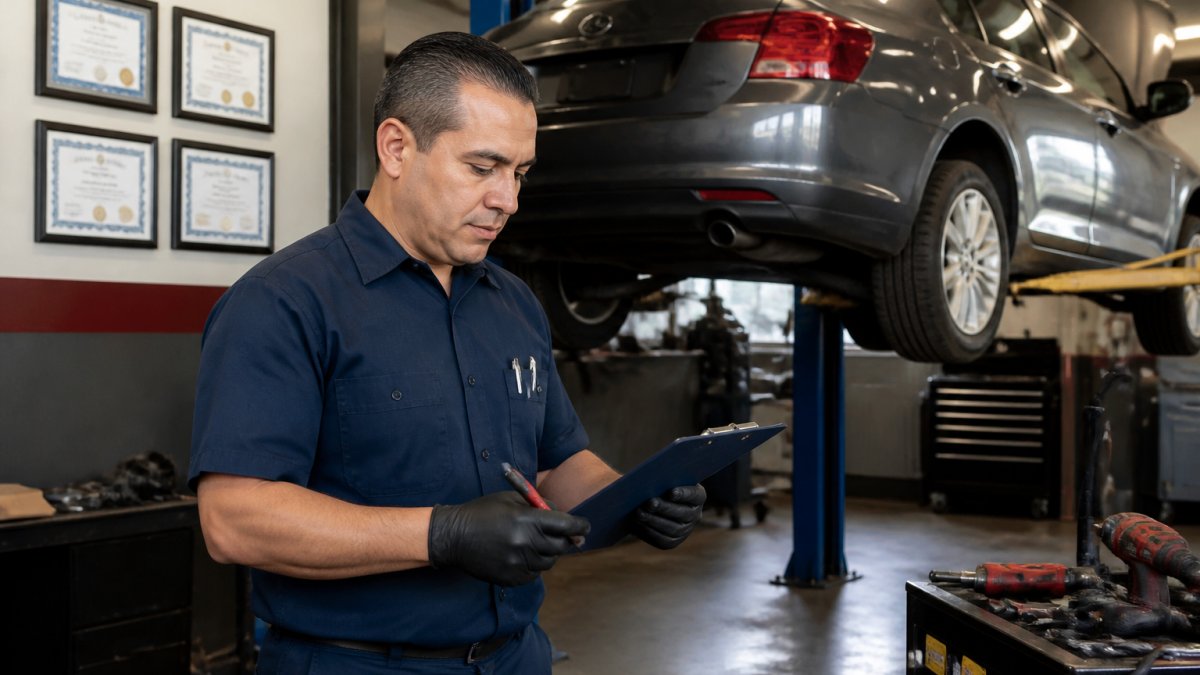
What most guides miss is that certification is specialty-specific. A technician certified in brakes is not automatically certified in electrical systems. When you see multiple credentials on the wall, that tells you the shop invested in breadth, not just one badge.
The credential rests on a short list of requirements a technician must meet and keep meeting.
| Requirement | What it involves |
|---|---|
| Certification exam | Passing score in the specific specialty |
| Work experience | Documented experience before the credential is issued |
| Recertification | Renewed on a regular cycle to stay current |
| Continuing education | Keeping up as vehicle systems evolve |
| Specialty scope | Each credential covers one area, not all systems |
Is ASE Certification Worth It for Technicians and the Shops That Hire Them
For technicians, the answer is usually yes, but the value is not automatic. Certification improves marketability and opens career advancement paths, and it signals professional credibility to every employer reading a resume. The catch is that the credential pays off only when it is paired with documented experience and a specialty that shops actually need.
Here is how the value actually converts, for each side of the counter.
For technicians, certification works through three mechanisms:
- Hiring filters. Many shops and dealerships list ASE certification as a preferred or required qualification, so the credential gets a resume past screens that a comparable uncertified tech never reaches.
- Specialty leverage. Because each credential is area-specific, a technician who stacks engine performance, electrical, and advanced driver assistance system (ADAS) credentials can bid for diagnostic work that general maintenance techs cannot claim.
- Employer-supported advancement. A common pattern is for shops to reimburse exam fees or pay a certification differential once a tech passes. That is a shop-by-shop policy, not an industry guarantee, so it belongs in the offer conversation, not the assumption.
On pay, be careful with the promises floating around online. ASE certification is associated with higher earning potential, but it does not by itself set a wage. A newly certified tech with two years of experience and a 20-year master tech with multiple specialties will not earn the same, and location and specialty shift the range again. Treat certification as one input among experience, specialty demand, and shop type.
For shops, the math runs through retention and risk:
- Certified teams tend to produce steadier service quality, which shows up in fewer comebacks and better customer satisfaction.
- Credentials are a visible trust signal that helps a shop win trust faster than one that cannot point to them.
- A shop that pays for certification and recertification creates a reason for techs to stay, which protects the investment in training.
The honest limits matter too. Certification is not a guarantee of good work, and it does not replace experience. A newly certified tech still needs mentoring. Certification is a floor, not a ceiling.
Our own path says something about this. SHEA'S AUTOMOTIVE has been family-owned and operated since 2008. You can read more about our commitment to learning and growth and see auto technician jobs for techs who want to work at a shop that takes credentials seriously.
How to Verify Mechanic Repair Estimates Before You Approve Work
Before you approve any work, verify the credential behind the estimate. ASE certification is only meaningful if it is current and covers the repair being quoted, and that is something you can check yourself in a few minutes.
Step 1: Confirm the credential is current. ASE credentials are renewed on a regular cycle, so a badge on the wall from years ago may no longer be active. Ask the shop which technicians hold current certification and in which specialties.
Step 2: Match the specialty to the repair. Certification is area-specific. A technician certified in brakes is not automatically certified in electrical systems or engine performance. If your estimate is for a diagnostic electrical fault, ask whether the tech assigned holds the relevant credential.
Step 3: Use the public registry. ASE maintains a searchable online directory of certified professionals. Ask for the technician's name and certification number, then confirm the status and specialty directly rather than relying on a framed certificate.
Step 4: Read the estimate against the credential. A written, detailed estimate should list each repair, the parts, and the labor separately. If a shop hands you one lump number, ask for the breakdown before you sign anything.
Use this checklist before you approve:
- The shop confirmed which technicians hold current ASE certification and in which specialties
- The assigned tech's credential matches the repair being quoted
- Every line item names a specific part or service
- Parts are listed as new, remanufactured, or used
- Labor is broken out, not folded into parts
- The shop will show you the failed part or the diagnostic evidence
- Diagnostic fees are stated up front
- Nothing gets added without your approval
Watch out: the most common trap is a vague estimate that grows after the car is on the lift, paired with a credential claim nobody checked. Ask what happens if the shop finds something else, and get the answer in writing.
If you want a deeper walkthrough, our guide on how to verify car repair estimates covers each line, and the step-by-step verification guide goes further into the questions worth asking.
How to Choose a Reliable Mechanic Without Guessing
Choosing a reliable mechanic comes down to three checks: credentials, communication, and evidence. Get all three and you rarely get burned.
Credentials. Look for ASE certification displayed where you can see it. Ask which specialties the shop holds.
Communication. A good shop explains the repair in plain language. If you leave confused, that is a signal.
Evidence. Ask to see the worn part or the diagnostic readout. A shop with nothing to hide will show you.
A few more things worth checking:
- Written estimates as standard practice, not on request
- Clear answers about turnaround time
- A willingness to prioritize safety items over upsells
The FTC's guidance on auto repair basics is a useful read before you visit any shop. It lays out your rights and what a shop should tell you up front.
Book Your Next Service With ASE Certified Technicians
The benefits of ASE certified technicians come down to one thing: proof. Proof of testing, proof of experience, and proof that the person working on your car has been held to a standard.
That is the standard we hold at SHEA'S AUTOMOTIVE. Our team is ASE-certified, we provide written, detailed estimates, and we aim to explain every repair in plain language. Whether you drive a daily commuter, a European model, or run a commercial fleet, we aim to give every vehicle the same level of care.
Ready to schedule? Get in touch with us to book your next service.
Frequently Asked Questions
Do ASE certified technicians actually provide better repairs?
Certification does not replace experience, but it sets a floor. An ASE certified technician has passed independent testing on specific vehicle systems and must recertify to keep the credential current, so their knowledge does not go stale. Shops that staff certified technicians also tend to follow documented repair procedures. Ask the shop which certifications apply to the job you need, and whether they will walk you through the diagnosis.
How can I verify that a mechanic is ASE certified?
Ask the shop directly which technicians hold current ASE credentials and in which service areas, such as brakes, electrical systems, or engine performance. You can also check the ASE website's credential lookup, which confirms whether an individual's certification is active. If a shop is vague about who is certified or cannot name a specific person, treat that as a signal to keep asking questions.
Is ASE certification worth it for customers, or is it just a plaque on the wall?
It is worth it when you use it as one of several checks. Certification tells you the technician passed a standardized exam on the systems they repair and committed to continuing education and recertification. Pair that with a written estimate, a clear explanation of the diagnosis, and a shop willing to show you the failed part. Credentials alone do not guarantee a perfect outcome, but they narrow the field and give you a concrete question to ask before you hand over the keys.
How do I compare repair estimates from different shops fairly?
Compare line by line, not by the bottom number. A lower estimate may omit a needed part, use a lower-grade component, or skip the diagnostic step entirely. Ask each shop to itemize parts and labor separately, state whether the price includes tax and shop supplies, and explain what happens if they find additional problems mid-repair. Confirm the estimate is in writing before work starts. A shop that explains its reasoning and puts everything in writing is easier to trust than one that quotes a single lump sum over the phone.
Finding a shop you can trust should not feel like a gamble. At SHEA'S AUTOMOTIVE, ASE-certified technicians, written estimates, and clear explanations of every repair are standard on every visit. Get started with SHEA'S AUTOMOTIVE and know exactly what is happening under your hood.