 blog
Affordable Fleet Maintenance Programs in Albuquerque
Table of Contents
- What Affordable Fleet Maintenance Programs in Albuquerque Should Include
- Fleet Preventive Maintenance Schedule: Intervals That Protect Your Vehicles
- Understanding Fleet Maintenance Costs and Where You Can Save
- Fleet Maintenance Program Checklist: What to Verify Before You Sign
- Fleet Downtime Reduction: Turnaround Times and Emergency Support
- How to Evaluate a Fleet Maintenance Provider in Albuquerque
- Conclusion
- Frequently Asked Questions
Last Updated: October 16, 2026
What Affordable Fleet Maintenance Programs in Albuquerque Should Include
A fleet maintenance program is a scheduled plan of inspections, servicing, and repairs that keeps commercial vehicles safe, compliant, and on the road.
The gap between a cheap program and a good one comes down to what's included. A low monthly rate means nothing if the plan skips the inspections that catch a failing alternator before it strands a driver.
Core Services Every Program Needs
Any fleet maintenance program worth signing should cover six service areas:
- Preventive maintenance - oil and filter changes, fluid checks, belt and hose inspection, tire rotation
- Mechanical repair - brakes, suspension, steering, engine and transmission work
- Electrical diagnostics - fault tracing, sensor testing, module scans
The Federal Motor Carrier Safety Administration's vehicle maintenance guidance treats systematic inspection and record-keeping as a core part of operating commercial vehicles, not an optional extra. If a provider's program doesn't include documented inspections, it isn't really a program.
How to Compare Local Providers Side by Side
Most fleet operators compare on price alone. That's the mistake. Compare on four things: what's included, turnaround time, how estimates are handled, and whether the shop documents every visit.
Ask each provider for a written scope of services, then ask what happens when a repair falls outside it. Written, detailed estimates give you a number you can plan around; verbal quotes leave you exposed to surprise line items.
Fleet Preventive Maintenance Schedule: Intervals That Protect Your Vehicles
A fleet preventive maintenance schedule sets fixed mileage or time intervals for each service, so nothing gets deferred until it fails. Intervals depend on vehicle type, duty cycle, and mileage, but a standard commercial baseline looks like this:
| Service | Interval | Why It Matters |
|---|---|---|
| Oil and filter change | 5,000-7,500 miles | Protects engine life |
| Tire rotation and pressure check | 5,000-8,000 miles | Prevents uneven wear |
| Brake inspection | 10,000-15,000 miles | Safety and liability |
| Battery and charging system test | Every 6 months | Catches weak batteries early |
| Full electrical diagnostics | Annually or on warning | Prevents electrical failures |
| Coolant and fluid service | 30,000 miles or per manual | Avoids overheating |
Heavy-duty work vehicles that idle frequently should be serviced on the shorter end of each range. Stop-and-go city routes wear brakes and transmissions faster than highway miles.
Understanding Fleet Maintenance Costs and Where You Can Save
Fleet maintenance costs come from three places: scheduled servicing, unscheduled repairs, and downtime. The first is predictable and cheap, the second is expensive, and the third hurts most, a vehicle in the bay isn't earning.
The savings come from shifting work from the second bucket into the first. A transmission replaced after a failure costs far more than the fluid service that would have prevented it, the same logic applies to batteries, brakes, and cooling systems.
What Actually Drives a Fleet Quote Up or Down
Two fleets with the same number of vehicles can get quotes that differ by thousands per year. The variables are consistent:
- Fleet size, Most shops tier pricing by unit count. A 3-vehicle fleet rarely qualifies for contract rates; a 15-vehicle fleet usually does. Ask where the tiers start.
- Vehicle class mix, Light-duty vans and pickups price close to passenger-car rates. Medium-duty work trucks, box trucks, and diesel units carry higher labor times and pricier parts. A mixed fleet is quoted as a blended rate, so ask how the blend is weighted.
- Duty cycle, A vehicle running 200 highway miles a day needs fewer visits per year than one doing 40 miles of stop-and-go with frequent idling. Idle hours, not just miles, drive service frequency.
How Fleet Discounts Are Typically Structured
There's no single industry-standard discount, but a few patterns show up across fleet programs:
- Volume tiers, A per-unit rate that drops as fleet size crosses thresholds (often around 5, 10, and 20 units).
- Bundled PM pricing, A flat rate per vehicle for a defined preventive maintenance package, billed whether or not every item is needed.
- Labor rate reduction, A lower hourly labor rate for fleet accounts, with parts billed at standard markup.
Ask each provider which structure they use and get the tier thresholds in writing. A discount you can't see the math behind isn't one you can budget around.
How to Request Comparable Quotes
Comparing advertised rates is a trap, a low headline rate often excludes the services that matter most. To get quotes you can line up side by side, give every provider the same input:
- A unit list with year, make, model, and vehicle class.
- Current odometer readings and average monthly mileage per unit.
- Your duty cycle description (highway, city, mixed, idling-heavy).
- The PM scope you want quoted, itemized.
- Your expected annual visit count per vehicle.
When every provider quotes the same scope against the same inputs, the differences are real. When they don't, you're comparing a full program against a partial one.
Where you can save without cutting corners:
- Bundle scheduled services into one visit instead of three separate appointments
- Fix small issues during routine service rather than waiting for a dedicated repair visit
- Track costs per vehicle so you can spot the unit that's quietly draining your budget
Fleet Maintenance Program Checklist: What to Verify Before You Sign
Use this checklist before committing to any fleet maintenance program:
- Written scope of services, including what is and isn't covered
- Preventive maintenance intervals documented per vehicle type
- Customer reviews and ratings checked independently
The last two items carry more weight than most operators give them. ASE-certified technicians and a Certified Auto Repair-affiliated facility signal a shop that meets recognized standards; customer reviews tell you whether it delivers on them.
Fleet Downtime Reduction: Turnaround Times and Emergency Support
Fleet downtime reduction starts with one question: how fast can this shop diagnose and return a vehicle? Diagnostics speed matters more than repair speed, because you can't authorize a repair until someone knows what's wrong.
A shop with strong diagnostic capability identifies the fault on the first visit. A shop without it orders parts on a guess, waits, installs, and finds the problem is still there, that's where fleets lose days.
Questions to Ask About Repair Turnaround
- How quickly do you complete diagnostics on a commercial vehicle?
- Do you offer same-day service for breakdowns?
- What's your process when a part isn't in stock?
Get answers in writing. A verbal "we're usually pretty fast" is not a turnaround commitment. The U.S. Department of Energy's vehicle maintenance resources notes that well-maintained vehicles stay in service longer and cost less to operate, which is the entire point of a fleet program.
How to Evaluate a Fleet Maintenance Provider in Albuquerque
Most fleet operators rank price first. Flip that. Price is the fifth criterion, not the first. The four that matter more are service coverage, diagnostic capability, reporting and accountability, and fit for your fleet's size and vehicle mix.
A Scoring Framework You Can Actually Use
Score each candidate from 1 to 5 on the criteria below, then weight them. A simple weighting for most small and mid-sized fleets:
| Criterion | Weight | What a 5 Looks Like |
|---|---|---|
| Service coverage | 20% | Mechanical, electrical, battery/starter/alternator, wiring, lighting, and diagnostics all in-house |
| Diagnostic capability | 20% | Commercial-vehicle scan tools, first-visit fault identification, documented findings |
| Reporting and records | 20% | Per-unit service history you can export, itemized invoices, interval tracking |
| Fleet size and vehicle fit | 15% | Handles your unit count and your heaviest vehicle class without outsourcing |
| Turnaround and emergency support | 15% | Stated diagnostic and repair timeframes, after-hours or same-day availability |
| Price and agreement terms | 10% | Written scope, transparent discount structure, no surprise line items |
A provider that scores 5 on price but 2 on diagnostic capability will cost more over a year than one scoring 4 on both. Downtime never shows up on the quote.
Service Coverage and Diagnostic Capability
Start with coverage. Can the shop handle mechanical repair, electrical work, battery and starter service, wiring, lighting, and diagnostics under one roof? Every extra shop you coordinate with adds a day to turnaround and a gap in your records.
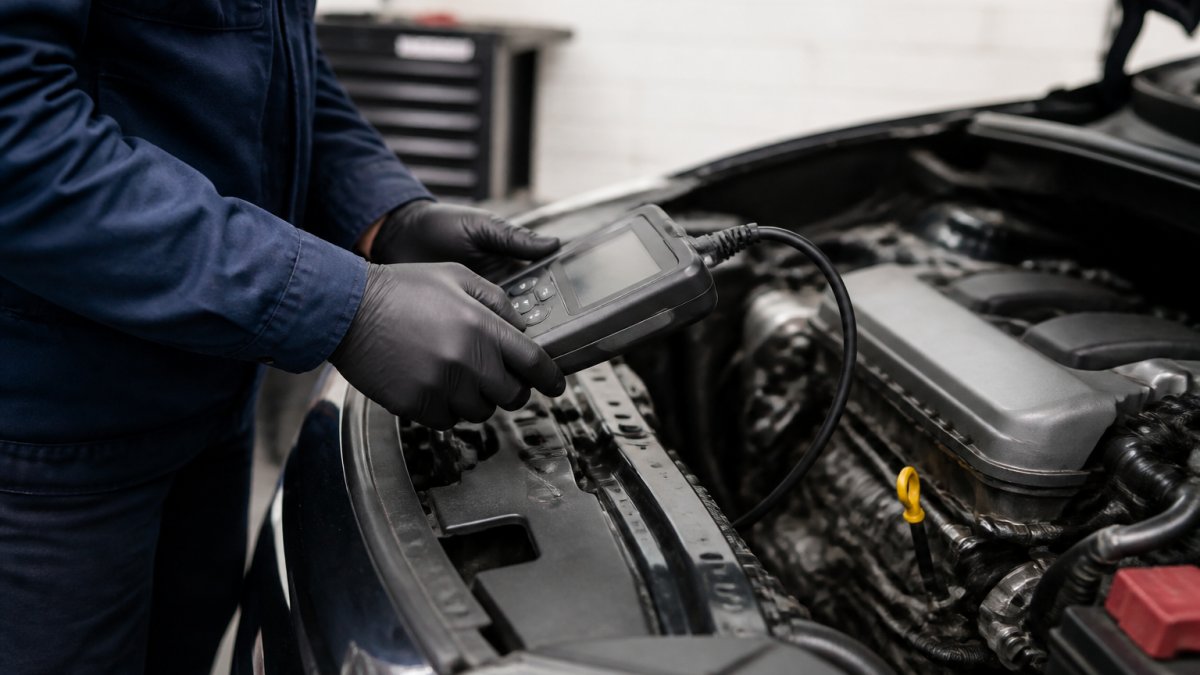
Then look at diagnostics. Ask what scan tools they use on commercial vehicles and whether they can pull body and chassis codes, not just engine codes.
Reporting, Records, and Accountability
Does the shop document every visit and hand you service records you can file or export? Maintenance tracking turns a repair history into a maintenance plan; without records, you're guessing at intervals and repeating repairs.
Ask specifically:
- Do you provide per-unit service history on request?
- Are invoices itemized by labor, parts, and diagnostic time?
- Do you flag when a vehicle is approaching its next interval?
A shop that answers yes to all four without hesitation is tracking maintenance as a system, not a series of transactions.
Fleet Size and Vehicle Type Fit
This is the criterion most operators skip, and it causes the most mid-contract surprises. Commercial vans, light trucks, medium-duty work trucks, and diesel units have different service needs, lift requirements, and diagnostic equipment.
Ask directly:
- What's the largest vehicle class you service in-house?
- What's the smallest fleet you take on contract?
- Do you outsource any work, and if so, which categories?
If the shop outsources electrical or transmission work, that's not automatically disqualifying, but know it before you sign, because outsourced work adds turnaround time you didn't budget for.
Warranty, Parts, and Service Agreement Terms
Before you sign anything, get these in writing:
- Parts warranty, How long, and does it cover labor or parts only?
- Repair warranty, What's the window, and does it apply to fleet accounts the same as retail?
- Parts policy, OEM, aftermarket, or your choice? Who decides?
A written service agreement that spells out all five protects both sides. A verbal understanding protects neither.
Communication and Turnaround Commitments
At SHEA'S AUTOMOTIVE, we provide written, detailed estimates and walk fleet managers through what we found before any work begins. That matters when you're approving repairs on a vehicle you didn't personally inspect.
Get turnaround answers in writing too: diagnostic timeframes, same-day service availability for breakdowns, and the process when a part isn't in stock.
Conclusion
Running a fleet means every vehicle in the shop is revenue sitting still.
SHEA'S AUTOMOTIVE is a family-owned shop with ASE-certified technicians and a Certified Auto Repair affiliation, handling commercial fleet work alongside routine maintenance. We provide written, detailed estimates, explain every repair in plain language, and keep the service records your fleet needs.
Get started with SHEA'S AUTOMOTIVE and keep your vehicles on the road instead of in the bay.
Frequently Asked Questions
What should an affordable fleet maintenance program include?
A solid program covers preventive maintenance like oil changes, brake inspections, tire rotations, and fluid checks, plus diagnostics and repairs for mechanical and electrical systems. It should also include a fleet preventive maintenance schedule, digital vehicle records, and clear communication about upcoming needs. Ask whether the provider offers written estimates and can handle your specific vehicle types, from sedans to work trucks. A good program prevents breakdowns rather than just reacting to them.
How can a business reduce fleet maintenance costs?
Start with a preventive maintenance schedule tailored to your mileage and vehicle types. Catching small issues early avoids expensive repairs later. Track fleet maintenance costs per vehicle so you can spot patterns, like one van that keeps needing brake work. Compare providers on service quality and turnaround, not just the lowest oil change price. A shop that diagnoses accurately the first time saves you money on repeat visits and downtime.
How often should commercial vehicles receive preventive maintenance?
Most commercial vehicles need oil and filter changes every 5,000 to 7,500 miles, brake inspections every 10,000 to 15,000 miles, and a full bumper-to-bumper check at least twice a year. High-mileage work trucks may need more frequent service. Your fleet preventive maintenance schedule should account for how you use each vehicle. Stop-and-go driving wears components faster than highway miles, so adjust intervals based on actual driving conditions.
How do fleet maintenance programs help reduce vehicle downtime?
Programs reduce downtime by catching problems before they cause breakdowns, keeping parts in stock for common repairs, and offering scheduled appointments that fit your operating hours. Fleet downtime reduction also comes from fast diagnostics and clear communication about turnaround times. Ask potential providers how quickly they can get a vehicle in and out, and whether they offer emergency support. A shop that understands commercial schedules will prioritize getting your vehicles back on the road.